When artificial intelligence moves beyond answering and begins executing, what changes in our work?
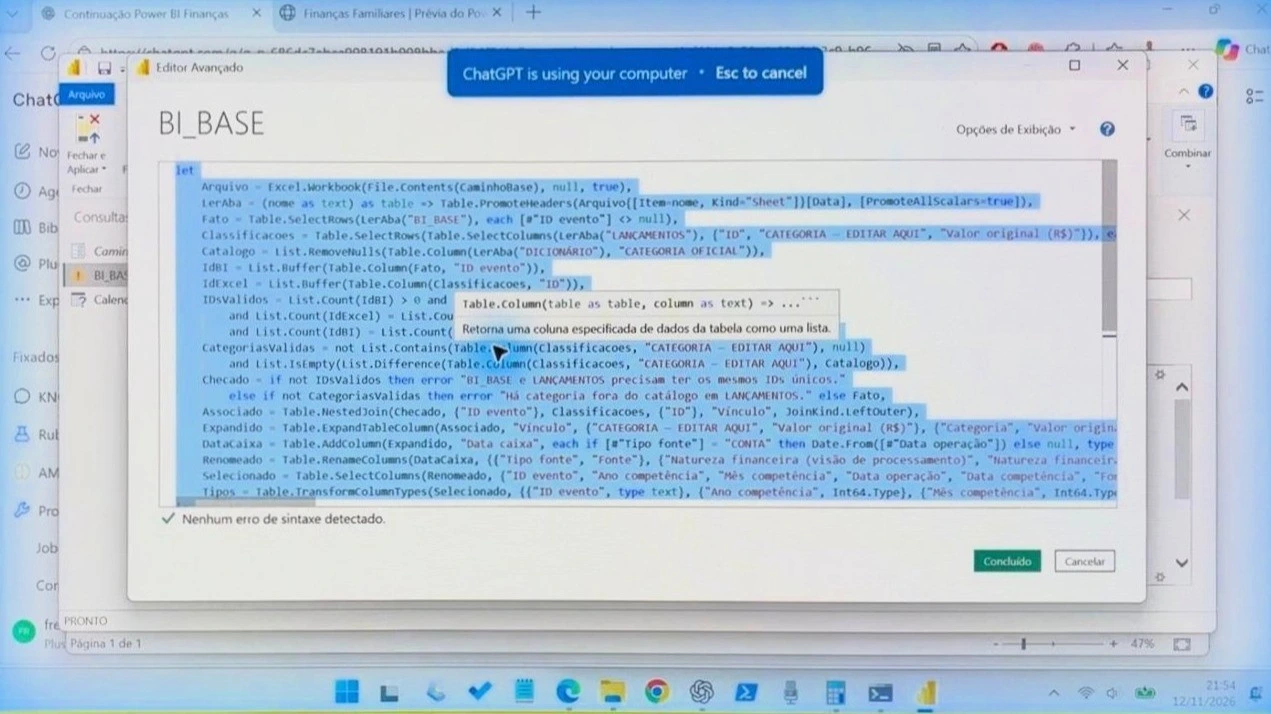
Recently, I had to pick up my phone and photograph a scene unfolding before my eyes: ChatGPT operating my computer, moving the mouse, opening tools and correcting errors in a dashboard it had built itself.
It looked like a remote support session, the kind where someone from IT takes control of our machine to solve a problem. The difference was that this time there was no person at the other end. It was artificial intelligence working directly on my computer.
And the most curious thing is that I am not exactly a newcomer to this world. I use ChatGPT Plus extensively and have been exploring Codex and so-called vibe coding to develop a SaaS and AI agents. I am not a programmer, but I have been experimenting with how to structure problems and proposed solutions so that AI itself can take part in their implementation.
Even with that familiarity, I had not yet tested a recent ChatGPT feature: the ability to operate the user's computer directly, with authorization. And my first test surprised me.
It all began during this career transition, when I decided to resume some personal projects. One of them was to improve the way I track my finances and investments, which I have maintained for years in good old Excel. As an engineer who enjoys numbers and already has experience building dashboards in Power BI, I decided to turn my spreadsheets into a more visual and interactive dashboard.
But this time, the challenge would be different: instead of building the dashboard myself, I wanted to see how far I could delegate its execution to AI.
With ChatGPT's help, I developed a Standard Operating Procedure (SOP) that, after successive refinements, reached 36 pages of instructions, business rules and requirements. The objective was to turn my knowledge of the problem into a sufficiently clear specification for AI to take on the execution.
The first version was built in about ten minutes, but it contained some errors. I identified and corrected several of them. For the remaining problems, I decided to try something new: instead of explaining how to fix them, I asked ChatGPT to investigate and resolve them.
That was when it requested permission to operate my computer.
I accepted and watched the AI working directly in Power BI, investigating the failures and implementing the corrections. In the end, the dashboard was working, with operational charts, indicators and projections. Only visual adjustments remained.
The initial structure, which would have taken me approximately two hours to build manually, had been produced in a fraction of that time. Naturally, corrections and validation required additional work, but the productivity gain was already evident.
However, what impressed me most was neither the speed nor the dashboard. It was realizing that we are entering a new stage in the evolution of artificial intelligence.
Until recently, our interaction with AI took place mainly through conversations. We asked for analyses, texts, code or guidance and then had to turn those answers into something functional. Now, with the advance of AI agents, that relationship is beginning to change: the machine not only proposes solutions but can also execute them, interact with different tools and participate in correcting its own errors.
We are moving from AI that teaches us how to do things to AI that can also do them.
And I believe this transformation will have profound consequences for the way we work.
For a long time, one of the greatest barriers between an idea and its realization was the technical ability required to execute it. We may understand a problem perfectly and imagine its solution, but implementing it requires time, specialized knowledge and mastery of tools.
As AI takes on a growing share of these activities, that barrier begins to diminish. As a result, the ability to structure problems and conceive solutions is likely to become even more important.
My experience with the SOP reinforced exactly that perception. The central challenge was not writing code or building charts, but correctly defining the problem, establishing the rules, specifying the expected outcomes and assessing whether the solution actually worked.
This does not mean that knowing how to program or use tools like Power BI will cease to be important. That knowledge remains essential for understanding possibilities, recognizing limitations and supervising deliverables. Nor does it mean that complex systems can be developed without specialized professionals, especially when security, integration and governance are involved.
But I believe we are beginning to separate two capabilities that have historically been closely linked: the ability to conceive a solution and the technical ability to execute it.
And this separation may transform the productivity of professionals and companies. A growing portion of operational effort could be delegated to machines, allowing us to devote more time to analysis, creativity, decision-making and solving more complex problems.
We are still at the beginning of this transformation. The tools make mistakes, require supervision and do not always finish what they start. But watching AI build something, encounter obstacles and participate in correcting its own creation seemed to me a very concrete demonstration of the potential of this evolution.
In the end, that photograph did not merely capture a technological curiosity. To me, it symbolized a much larger shift in the relationship between humans and machines.
Perhaps the greatest professional differentiator in the coming years will not simply be knowing how to execute a solution, but knowing how to identify the right problem, conceive the best response and guide artificial intelligence to turn it into reality.
If machines are learning to execute more and more of our work, perhaps it is time for us to devote more and more time to thinking about what is truly worth building.