Why Project Efficiency Must Be Engineered
For centuries, engineering has evolved around a simple principle:
making something work is not enough.
Anything can work.
True engineering begins when a harder question appears:
what is the most efficient way to make it work?
The difference may seem small, but in practice it is enormous.
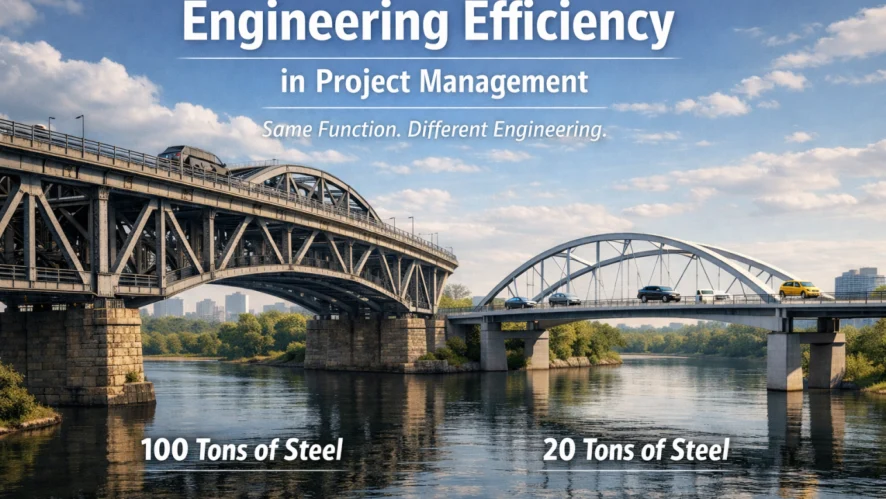
Imagine two bridges.
- Both cross the same river
- Both support the same load
- Both are safe
But one was built with 100 tons of steel.
The other with 20 tons.
Both work.
But only one represents true engineering.
The other is simply a solution that happened to work.
Engineering exists precisely for this: to transform trial into efficiency.
The invisible link between efficiency and profit
There is an implicit variable in this story that is rarely stated explicitly:
efficiency is profit.
If a bridge uses:
- 100 tons of steel
- instead of 20 tons
then the company:
- bought more material
- consumed more energy
- spent more time
- mobilized more labor
The result:
the project still works.
But profit disappears.
In practice:
| Poor engineering | Efficient engineering |
|---|---|
| Works | Works |
| Consumes excessive resources | Uses minimal resources |
| Low margin | High margin |
This is why engineering has always been linked to optimization.
- optimization of materials
- optimization of processes
- optimization of time
- optimization of energy
Always with one final objective:
extract maximum value with minimal resources.
The contradiction of corporate innovation
Interestingly, in many highly technical companies, this principle disappears when we enter the world of innovation and projects.
In process engineering:
- every variable is measured
- every yield is analyzed
- every loss is investigated
But in innovation project management:
- ideas emerge
- projects begin
- resources are allocated
- decisions are made
And we rarely ask:
- which project was conducted with greater efficiency?
- which phase generated the largest waste of time?
- which risks delayed projects the most?
- which decisions most impacted the final outcome?
In other words:
we execute projects, but we do not engineer project management.
Making projects work is not engineering
Just as a bridge can work with 100 tons of steel, a project can also succeed even when conducted extremely inefficiently.
Projects can reach the market:
- years late
- with massive rework
- with poorly tested hypotheses
- with poorly grounded decisions
And still be considered “successful.”
But this is not engineering.
This is project survival.
The question that should guide any innovative organization is different:
What is the most efficient way to transform ideas into results?
What was missing for the engineering of innovation
For decades there was a structural problem.
Even if we wanted to measure efficiency in innovation projects, it was difficult.
Because the data were:
- scattered across emails
- hidden inside presentations
- fragmented across spreadsheets
- lost in meetings
Project management was, to a large extent, human memory.
This made it nearly impossible to identify patterns such as:
- which types of risks appear most often
- which decisions delay projects
- which hypotheses fail more frequently
- which phases consume more time than they should
Without patterns, there is no engineering.
The new variable: artificial intelligence
Artificial intelligence radically changes this scenario.
Because it allows large volumes of dispersed information to be transformed into analyzable patterns.
Economists studying AI explain that the current wave of artificial intelligence essentially reduces the cost of prediction and decision analysis.
When prediction becomes cheap, something powerful happens:
decisions can be systematically analyzed.
This opens the door to something that was previously almost impossible:
engineering decision-making.
The engineering of project management
When project data begin to be structured and analyzed by intelligent systems, we start answering questions that were previously invisible.
For example:
- which projects have the highest probability of success?
- which risks are underestimated?
- which decisions generate the most delay?
- which hypotheses are weakest?
Gradually, what used to be intuition becomes engineering.
Just as in bridge construction.
Before:
- trial
- experience
- error
After:
- modeling
- calculation
- optimization
The new standard of efficiency
If in the past engineering efficiency was measured in:
- tons of steel
- energy consumption
- process yield
In the future of innovation it will be measured in:
- time to decision
- learning rate per project
- reduction of rework
- probability of success
In other words:
cognitive efficiency.
Artificial intelligence does not replace leadership or human creativity.
But it creates something that previously did not exist:
an analytical infrastructure for complex decisions.
The transition that is beginning
We are entering a new phase of engineering.
During the twentieth century, we learned to optimize:
- machines
- processes
- materials
In the twenty-first century, we are beginning to optimize something far more complex:
how organizations think and make decisions.
Engineering innovation will not only be about creating new technologies.
It will be about creating systems that make the innovation process increasingly efficient.
Just like in bridge construction.
In the end, two bridges may cross the same river.
But only one represents true engineering.