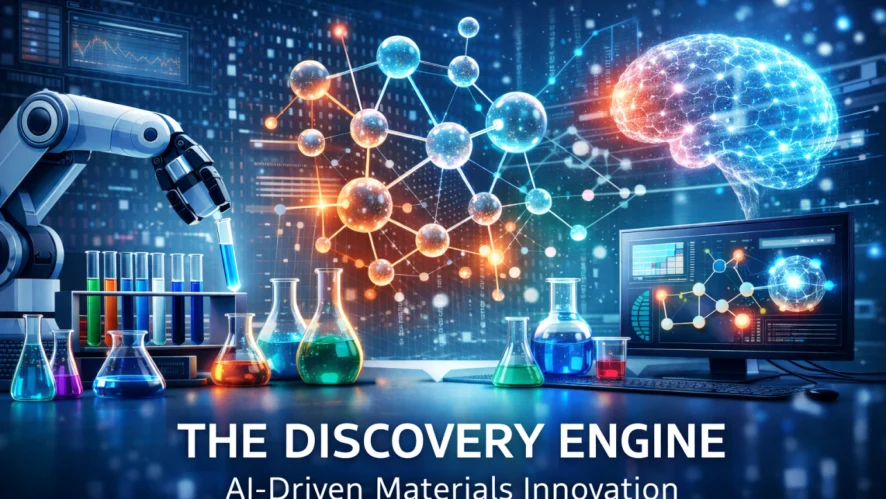
The next big innovation in materials science may not be a new material.
It may be a new way of discovering materials.
For decades, industrial innovation followed a familiar pattern.
A research team formulates an idea.
Experiments are designed.
Data is collected.
The hypothesis is refined.
The process works.
But there is a quiet problem inside this model.
Even in companies with world-class scientists and sophisticated laboratories, innovation often remains slow and expensive.
The bottleneck is rarely experimental capability.
The real problem often appears before the first experiment even starts.
Weak hypotheses.
When the initial hypothesis is not strong enough, the laboratory becomes an expensive machine for trial and error.
Experiments are not validating ideas.
They are searching for the right question.
The real challenge of materials science
The space of possibilities is enormous.
When developing a polymer material, for example, final properties may depend on:
- molecular architecture
- catalyst systems
- process conditions
- additives and formulations
- morphology development
- processing parameters
Each variable interacts with the others.
The number of possible combinations quickly explodes beyond human intuition.
Historically, we navigated this space through:
experience + experimental iteration.
That approach worked for decades.
But the complexity of modern materials systems is pushing it to its limits.
A quiet shift is happening
In some of the most advanced research environments, a different model is emerging.
Not because of AI alone.
Not because of automation alone.
Not because of simulation alone.
But because of the convergence of all three.
This shift is transforming something deeper than research tools.
It is changing how scientific discovery itself works.
Closed-Loop R&D
Traditional R&D looks like this:
experiment → analysis → learning.
Closed-loop R&D looks different.
data → model → hypothesis → experiment → new data → updated model.
The laboratory becomes a learning system.
The goal is no longer to run more experiments.
The goal is to maximize learning per experiment.
Self-Driving Laboratories
Some research centers have taken this idea even further.
They are building self-driving labs.
The concept is surprisingly simple:
- algorithms analyze existing data
- they propose new experiments
- automated systems run those experiments
- results feed back into the models
The cycle continues.
Scientists do not disappear.
Their role becomes even more important.
They focus on:
- framing better questions
- interpreting emerging patterns
- guiding exploration
The SpaceX analogy
One of the most interesting parallels comes from aerospace engineering.
For decades, the dominant philosophy was:
design → simulate → perfect → build.
SpaceX flipped that model.
Rapid prototyping. Frequent testing. Accelerated learning.
Failures were not the end.
They were data.
Engineering became a learning engine.
The rise of Materials Informatics
Today we are seeing the emergence of a field called:
Materials Informatics
The idea is simple.
Use data science and AI to extract knowledge from the vast experimental datasets accumulated by industry over decades.
When you connect:
- experimental data
- scientific literature
- computational models
- machine learning
- targeted experimentation
something powerful begins to appear.
A system that functions as a discovery engine.
The real shift
The next competitive advantage in industrial R&D may not be:
bigger labs.
more scientists.
more experiments.
It may be something else entirely.
Better systems for generating hypotheses.
Because in the end,
scientific innovation does not start with experiments.
It starts with better questions.
#MaterialsScience
#AdvancedMaterials
#ArtificialIntelligence
#ResearchAndDevelopment #MaterialsInformatics
#DeepTech
#Innovation