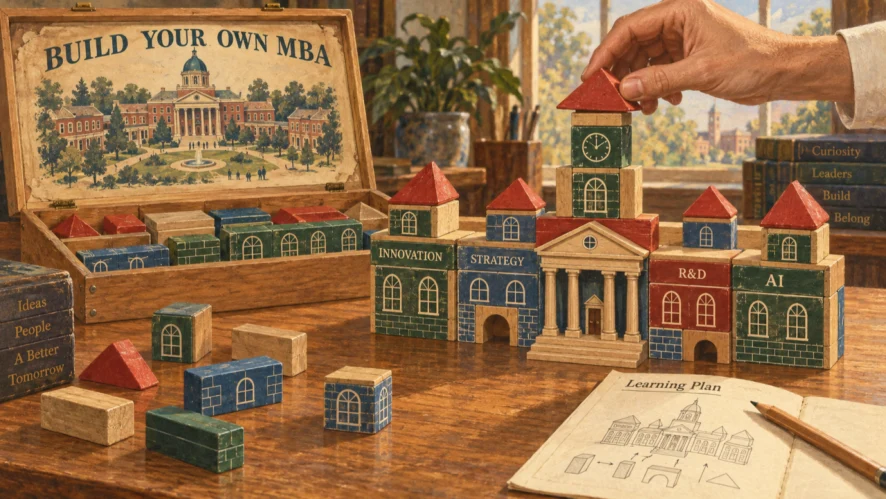
How I designed a two-year learning journey in Innovation Intelligence & R&D Transformation with AI.
After completing my MBA in Leadership, Team Management and Productivity at PUCRS, I started thinking about how to continue my education.
My final project explored AI agents as cognitive assistants in innovation project management. It brought together my experience in R&D projects and an interest I had been developing through practical experimentation: using AI to retrieve knowledge, understand context and support decisions.
The program provided a strong foundation and encouraged me to keep exploring these subjects. I looked into several postgraduate programs, and while there were good options, I couldn’t find the combination of subjects, flexibility and cost I was looking for.
At some point, I realized I could use AI to help design the learning experience I had in mind.
The idea grew out of my interest in projects, innovation and AI, and a collection of books I wanted to explore. I decided to build a curriculum around those interests, connecting the readings into a two-year study plan with a clear purpose.
That became my personal study program in Innovation Intelligence & R&D Transformation.
I call it my own “MBA,” although it is a self-directed learning program, not an accredited degree.
Giving the bibliography a purpose
I organized a collection of more than 100 reference works and selected a core bibliography for the initial program.
It brings together innovation management, strategy, decision science, systems thinking, organizational knowledge, leadership and applied AI. Authors include Tidd and Bessant, Robert Cooper, Clayton Christensen, Nonaka and Takeuchi, Herbert Simon, Amy Edmondson and Chip Huyen, alongside PMI standards and the NASA Systems Engineering Handbook.
Having that material available raised an interesting question: how could I connect these readings around the subjects I wanted to study?
There is an obvious temptation to ask AI to connect everything. But two authors discussing the same subject does not automatically make that subject relevant to the curriculum. Nor does including a book mean I should read every chapter.
I used a simple sequence to guide the selection:
Topics of interest → learning objectives → selected readings → connections across sources → practical application.
Each reading has a purpose, with room to compare authors, question assumptions and explore different perspectives. Connections between sources become part of the curriculum when they support a defined learning objective.
The first version of the curriculum
Working across multiple AI tools, I developed an initial two-year plan with eight modules:
- Strategy and Innovation Intelligence: Identifying opportunities, evaluating information and making strategic choices.
- Innovation Management and Research-to-Market: Turning technical and commercial uncertainty into experiments, learning and development decisions.
- Projects, Programs and Portfolios: Connecting priorities, resources, dependencies, governance and expected benefits.
- Decision Quality and Economic Value: Working with incomplete evidence, examining assumptions and building defensible business cases.
- Data, Information and Knowledge for R&D: Understanding how knowledge is organized, preserved, retrieved and used across teams.
- Applied AI and Digital Products: Framing use cases, understanding solution architectures and evaluating performance.
- Workflow Transformation, Integration and Assurance: Exploring the processes, interfaces and controls needed to turn experiments into reliable capabilities.
- Leadership, Influence and Organizational Learning: Examining collaboration, communication, adoption and collective learning.
The plan includes an initial self-assessment, module quizzes, practical exercises and a final case study connecting the subjects.
Some topics call for deeper reading and discussion; others lend themselves to experimentation and small prototypes. The two-year horizon provides a starting framework, with flexibility to adjust the pace as the study progresses.
Turning the plan into a study environment
I used ChatGPT to help structure the curriculum and brought the selected references into Google’s NotebookLM.
A Master Knowledge Base brings together the syllabus, learning objectives, reading approach and study plan. It will also hold the notes and synthesis developed along the way.
NotebookLM offers several ways to explore the material. Mind maps reveal how topics branch out and connect. Audio overviews make it possible to revisit a subject during a commute. Video overviews, structured reports, flashcards and quizzes provide additional ways to study and review.
I can investigate a question across different books, compare perspectives and consult the passages supporting an answer. AI-generated interpretations still need to be checked against the original sources.
This is one of the aspects I find most interesting: being able to move between a broad view of a subject and a focused discussion of a specific concept, while keeping the references close at hand.
The curriculum gives that exploration direction. There is also room to follow an interesting question without turning every discovery into another mandatory topic.
Ready to start
The first version is now ready, and I’m looking forward to working through it: reading, exploring connections, testing my understanding and applying ideas through exercises and case studies.
Completing a formal MBA gave me a strong foundation. Building this personal program has been an enjoyable way to plan what I want to learn next—and to explore what AI can contribute to that process.
Of course, there are things I’ll miss from the university experience: conversations with professors, learning alongside classmates, and the certificate at the end.
I suppose I could ask AI to design the certificate. But that would be the easiest assignment—and the least meaningful one. 🙂
#ArtificialIntelligence #Innovation #ResearchAndDevelopment #ProjectManagement #DigitalTransformation #LifelongLearning